Blog
Vegetable garden productive cycle
Just one hour from Seville arriving to Tentudia region, Ranch Biensevive and its organized holiday walkings you will be overwhelmed by beautiful scenery but above all by countryside local knowledge.
I call it “micro tourism” (to have access to local knowledge and experiences) Ranch Biensevive brings back to live traditional vegetable garden (huerta) agroecosystem. Most vegetable production arrives in summer season. Planting starts in spring and fruits come throughout summer. Before planting we have to prepare the land, with one previous soil working to oxygenate it and take off unwanted grass and later on another one to level the ground and leave it in the best planting conditions.
The first soil working (“alza”, meaning to remove soil upwards) in Sierra Tentudia is done in February and it is used the plough (carried with donkey). The second soil working is in march or april (“bina”, meaning in latin second), depending on each year raining weather conditions, although this time plough is introduced less deep inside soil (“menos tiro”).
At this time depending of types of soil it is also used “la máquina” (made of heavy iron sticks and wood) to break clods and level the ground Besides working the soil it is so important to fertilize it, because although vegetable gardens are located in fertile areas, with very rich soil, it is intensive cultivation, planting every year, and soil needs nutrients.
—————
Organic Vegetable Garden (Huerto). Permaculture system of cultivation:
Organic Vegetable Garden (Huerto). Part 2 - Permaculture system of cultivation:
Walking In Tentudia region brings you back to traditional agriculture: it is very common in vegetable gardens to grow cereals and also raise pigs. It is a combined cultivation of vegetable, cereal and fruit trees with the raising of cows, goats and pigs. Mules and donkeys are very important for vegetable gardens (work the land, waterwheel, transportation) and also a source of manure to sustain this agro-ecosystem. Potatoes, tomatos, vegetables, green beans,... are basic food for a healthy diet
It is also a singular characteristic of this small huertos to have legume boiler (“cocedero de altramuces”). This is a small circular oven made of stone where you boil this legume (altramuz) and take off the acid taste. They are in the huertos because they need enough water to boil, It is used to feed the pigs.
Permaculture and organic farming is perfectly represented through this traditional way of managing agriculture and livestock in this huerta agroecosystem. Walking around Tentudia region will allow you to learn these things that are nearly gone.
—————
Vegetable Garden (Huerto vs Huerta). Definition, Location, Types
VEGETABLE GARDEN (HUERTO vs HUERTA) PART ONE: definition, location, types
Organic/traditional vegetable garden (huerta) existing in Tentudia in the fifties had such specific characteristics that made it a very particular organic agro ecosystem.
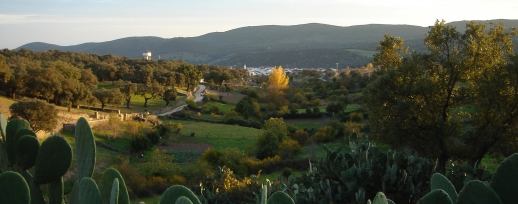
Today from spring to summer, we can fortunately still enjoy vegetable gardens while walking around Tentudia region.
Unlike extensive land exploitation, as Dehesa, vegetable garden (huerto/a) has always been based on intensive cultivation systems.
From fertile soil, water, and manure little oasis are created. With regard to water, it is hidden streams and river banks one of the main elements that determine the location of orchards and vegetable gardens in Tentudia region.
Rich soils with sediments are to be found close to rivers, apt to vegetable and fruit cultivation.
We can distinguish between huerto vs huerta. The latter has bigger dimension and produces enough to sell in village markets. They are nearly extinguished.
On the other hand, huerto, is a much smaller piece of land, and focused on family provisions and self consumption, still very popular around here.
—————
Ranch Biensevive
Today is April the 20th 2009, world crisis still monopolizing international media, meanwhile, in Andalucia, Spain, restoring of Cortijo Biensevive still takes place.
The challenge is to recover how in the old days agriculture and livestock uses interacted and were used complementarily, (goats, pigs, cows, eating the grass, fertilizing the soil, donkeys carrying things around,...). Dehesa agroecosystems magically combines it.
At the same time we want to enjoy the beauty of the sceneries through organizing walkings holidays in andalucian and extremadura countryside.
We have started a month ago, after architect provided us latest changes on the construction plans, each time we meet he keeps telling us: “Javier, you still cannot imagine what we are doing here”.
This is surprisingly just one hour away from the monumental Seville.
We invite you all to share with us the Walk Tentudia experience
—————
The beginnings of "Biensevive"
This is the story of Javier Aguirrebengoa's attempt to go "back to basics" in the mountains near his home in Sevilla, Andalucia An hours drive north of Seville takes you into the heart of the Sierra Morena. This is a massive range containing many smaller sierras. The Sierra de Aracena is quite popular, but the lesser known range of the Sierra de Tentudia is rarely visited. The Tentudia sit on the border of Andalucia and Extremadura. The Sierra de Tentudia are a range of hills and peaks north of the pleasant and rural town of Arroyomolinos de León, in the province of Huelva. Bonales (1058m), Cerro Gordo (1037m) and Tentudia itself (1110m) are the main peaks. There are no dramatic cliffs and faces here though. The area is very rural and at first glance, much greener than you would expect this close to the sizzling heat of Sevilla! There are no foreigners living here and the pace of life is slow.  We met our friend and guide, Javier Aguirrebengoa, and we swapped the comfort and luxury of modern saloon cars for the rough and tough 20 year old Nissan Patrol 4WD with nearly 400,000k on the clock! Javier has just bought a cortijo up at 900m above the town. As soon as we left Arroyomolinos we knew we in for something special. The track deteriorated instantly into a up and down switchback of stones, dirt and dried mud. After an hour of being jerked up, down and from side to side we arrived at the "road" end.
  Here was Javier's pride and joy, a small cortijo set amid 70,000 sq m of land. One room was habitable, the others reserved strictly for sheep and goats. Night was falling by this time as we gathered firewood and started the first basic necessity, which was to create warmth. Very soon we had a roaring fire going.
  The next basic was food and drink. Here Javier excelled with a feast of chorizo, local cheese, bread and tortilla washed down by some good red wine. Javier explained about the many local traditions hereabouts including the "Dehesa" system of self sufficiency. Dinner concluded with roasted banana with a honey and rum sauce!
 Sleeping arrangements were simple. A wooden slated bed and mattress on the floor and some blankets. With good food inside us and the heat of the fire keeping the cold at bay we had in fact a surprisingly comfortable night.
  Next morning dawned cold and misty. Javier's donkey, Federika, woke us. Federika is at least 20 years old (like the 4WD!) and is used for moving firewood from Javier's substantial holding to the cortijo. She also is used to carry water, building materials etc up from the town.
  We were taken on a tour of his land. The whole area is rich in diversity and a throwback to the old days. Giant oak trees (Robles) and chestnuts dominate but there is also olive. Javier explained the uses that the land, trees and plants had in the olden days. He intends to bring back these ways to his land. Then it was a tour around some of the other towns in the area such as Cabeza de la Vaca and Calera de Leon.
  I thoroughly recommend a trip to this interesting area. It is throwback to the days when self sufficiency in life was the norm not the exception. Javier is a lawer, speaks fluent english and is incredibly enthusiastic and knowledgeable about the area, its people, culture and eco-systems. If you wish to visit the area with him as your guide PLEASE contact Javier Aguirrebengoa.
—————
The start of it all
My name is Javier Aguirrebengoa. I purchased some land and a small cortijo in the mountains of the Sierra de Tentudia in 2008. I am currently passionately involved in restoring the cortijo and bringing self sufficiency into the lives of my family and myself. I hope this makes for interesting reading!
—————
First blog
Our new blog has been launched today. Stay focused on it and we will try to keep you informed. You can read new posts on this blog via the RSS feed.
Tags
Contact
Walk Tentudia
Javier Aguirrebengoa, Seville, Spain